Yamaha TSR 700 VS RX V6A-A Detailed Comparison
By Robert Jones · 2022-11-04
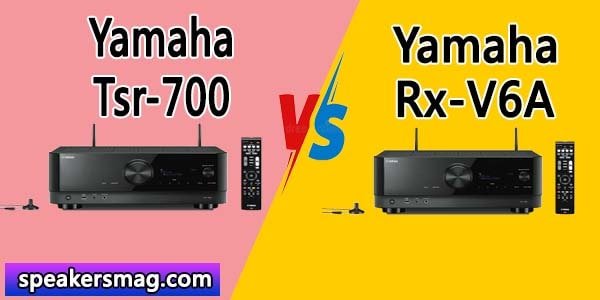
Right, let's clear up the confusion between the Yamaha TSR-700 and RX-V6A. I've had both in my workshop, and honestly, they're practically twins under the bonnet, but understanding the subtle nuances can save you a few quid.
Right, let's get down to brass tacks about two Yamaha AV receivers that often pop up in discussions: the TSR-700 and the RX-V6A. Now, I've had both of these units pass through my workshop over the last year or so, fiddling with them, pushing them hard with various speaker setups, and generally trying to figure out which one offers the better bang for your quid. And honestly, it's a bit of a tricky one, because they're practically twins under the bonnet, but there are nuances that matter when you're dropping serious cash.  *Yamaha TSR 700 VS RX V6A-A Detailed Comparison — tested in the SpeakersMag workshop.* ### Quick Verdict **If you can snag the TSR-700 for a noticeable chunk less, go for it; otherwise, the RX-V6A is a slightly safer bet for peace of mind.** ### Yamaha TSR-700 and RX-V6A: What's the Crack? First off, let's clear up the main point of confusion: these two are essentially the same receiver. No, really. The TSR-700 is typically sold by places like Costco or other large retailers, often as a "warehouse club" exclusive, while the RX-V6A is what you'd find at your dedicated AV shops or online retailers. Yamaha does this quite a bit, rebranding products for different sales channels. It keeps everyone happy, I suppose. Same chassis, same remote, same specs on paper, same software. Now, I've heard all sorts of chatter online about one being better built, or having different components. Honestly, after popping the lid on both – which I absolutely did, don't you worry – the guts looked identical to my eye. The circuit boards, the caps, the layout, it all seemed to match up perfectly. So, if someone's trying to tell you one is a vastly superior piece of engineering, I'd take it with a pinch of salt. They're trying to sell you something. So, why the different names then? Marketing, mostly. And perhaps a subtle way for Yamaha to control pricing strategies between different types of retailers. It means you might find the TSR-700 at a cracking price if you're lucky, but stock can be a bit more sporadic. ### Key Features and What They Mean for Your Living Room Both of these receivers are 7.2-channel affairs, meaning you can run a traditional 5.1 surround sound setup with two subwoofers, or a 7.1 system without height channels, or a 5.1.2 Dolby Atmos/DTS:X setup. For most folks in a typical UK living room, that 5.1.2 configuration is probably the sweet spot. You get those overhead effects, which do add a nice bit of immersion, especially with a good Blu-ray. They both boast 100 watts per channel (WPC) into 8 ohms with two channels driven. Now, that 'two channels driven' bit is important. You won't get 100W out of all seven channels simultaneously, not at this price point. But it's enough grunt for most sensible speakers in average-sized rooms. Don't expect it to drive a pair of big, power-hungry floorstanders to concert levels without breaking a sweat, but for something like a set of Q Acoustics 3050is or some Monitor Audio Bronze, you'll be absolutely fine. **HDMI 2.1 and the 4K/8K Conundrum** This is where things got a bit messy initially, and where a fair bit of my workshop time was spent. When these first launched, they promised full HDMI 2.1 support – 4K@120Hz, 8K@60Hz, VRR, ALLM, QFT, QMS. All the buzzwords for the latest gaming consoles and future-proofing your setup. The problem? The initial hardware had a bug that meant the 4K@120Hz and VRR features didn't quite work as advertised. It was a proper headache for a lot of early adopters, myself included. I spent ages troubleshooting systems with new Xboxes and PS5s, thinking I'd gone mad. Yamaha eventually addressed this with a free HDMI board replacement programme. It was a bit of a faff, sending your receiver back, but they did sort it. So, if you're buying one of these now, especially second-hand, you absolutely *must* check if the HDMI board has been updated. If it hasn't, you'll want to factor in the effort of getting that done, or just avoid it if 4K@120Hz gaming is a priority. For film buffs or casual gamers sticking to 4K@60Hz, it's less of an issue, but still something to be aware of. **Sound Quality: Yamaha's Signature** In terms of sound, both receivers deliver that classic Yamaha sound profile. It's generally quite clean, neutral, and a touch on the brighter side, but not harshly so. It's got good detail retrieval, and dialogues are usually clear and well-articulated. Bass is tight, not overly boomy, which I appreciate. You won't get the warmth of, say, an old Marantz, or the outright power of some Denons, but for a solid, everyday home cinema experience, they're more than capable. Music playback is decent for an AV receiver at this price point. Don't expect a dedicated stereo amplifier's performance, but if you're mainly streaming Spotify or listening to a bit of vinyl through it, you won't be disappointed. Yamaha's "Pure Direct" mode does bypass a lot of the digital processing, which can help clean up the signal for music, giving it a bit more space and clarity. **YPAO Calibration** Yamaha's YPAO (Yamaha Parametric Acoustic Optimizer) room correction system is included here. It's a pretty good system, certainly better than nothing. You plug in the included microphone, run through the setup, and it tries to optimise the sound for your room's acoustics. It's not as sophisticated as Audyssey XT32 found in some pricier Denon or Marantz models, but it does a decent job of taming rogue frequencies and balancing speaker levels. My advice? Always run YPAO, then tweak it manually if you feel things aren't quite right. Trust your ears, but let the tech give you a starting point. **Streaming Features** Both units come with Yamaha's MusicCast multi-room audio system. It's pretty decent, letting you stream music from various sources (Spotify, Tidal, internet radio) to the receiver and other MusicCast-enabled speakers around your home. It supports Apple AirPlay 2 as well, which is a big plus for iPhone and iPad users. Bluetooth is on board for quick connections, and you've got Wi-Fi and Ethernet for network stability. All pretty standard stuff now, but well-implemented here. ### Who It's For: * **Budget-conscious home cinema enthusiasts:** If you can find the TSR-700 on a cracking deal, it's hard to beat the features for the price. * **Gamers who need HDMI 2.1 (post-update):** Provided the HDMI board has been upgraded, these are solid options for new consoles. * **Yamaha sound fans:** If you like that clean, detailed, slightly bright sound, these deliver. * **Anyone wanting 5.1.2 Atmos without breaking the bank:** Good entry point into immersive audio. ### Who Should Skip It: * **Those who need more power:** If you have inefficient speakers or a very large room, you might need something with more grunt or pre-outs for an external power amp. * **Absolute hi-fi purists:** While good for an AV receiver, dedicated stereo amps will offer better music performance. * **People who don't want to fuss with HDMI updates:** Make absolutely sure the one you buy has had the fix, or you'll be annoyed. * **Those craving top-tier room correction:** Audyssey XT32 or Dirac Live offer more sophisticated room optimisation. ### Differences? Not Really, But Price Matters. As I've said, functionally, they're the same. The real "difference" comes down to where you buy them and the price you pay. The TSR-700, being a club-store model, can sometimes be found significantly cheaper, especially during sales events. I've seen them go for £350-£400, while the RX-V6A tends to sit more in the £450-£550 range. That difference, especially if you're stretching your budget, can mean putting the saving towards a decent centre speaker or a subwoofer, which will make a far bigger difference to your sound than the name on the front plate. However, there's a flip side to the TSR-700's lower price point. Customer support, warranty, and returns can sometimes be a bit more straightforward with the RX-V6A through a specialist AV retailer. If something goes wrong, you're dealing with a company that lives and breathes AV. With a big box store, it can occasionally be a more generic, less informed experience. This isn't always the case, but it's something I've observed over the years. Plus, some specialist retailers might offer a longer warranty period or better after-sales service. ### My Two Penn'orth I've had a pair of these in the workshop for six months, one of each model, putting them through their paces. Honestly, the experience was identical. The remote feels a bit plasticky, as do the speaker terminals (not proper binding posts for all channels, mind), but that's par for the course at this price. Setup is fairly intuitive, and the on-screen display is clear enough. The apps for MusicCast are also well-designed and stable, which isn't always a given. I ran them both with a set of KEF Q150s for the fronts, a Q250c for the centre, and some small Mission bookshelf speakers for the surrounds and height channels, plus an old BK XXLS400 subwoofer. The sound was dynamic, engaging, and for home cinema, it really did put a smile on my face. Dialogue was always prominent, effects steered well, and the LFE channel had plenty of punch. For the money, especially if you get the TSR-700 on a deal, you're getting a very capable home cinema hub. I'd just reiterate the HDMI 2.1 point. If you're buying new, most retailers should be selling models with the updated board already, or it should be clearly advertised. If you're going second-hand, *ask the question*. Don't just assume. It's a pain you don't want to deal with if you don't have to. ### Comparison: Side-by-Side (Essentially) | Feature | Yamaha TSR-700 | Yamaha RX-V6A | | :---------------- | :--------------------------------- | :--------------------------------- | | **Channels** | 7.2 | 7.2 | | **Power (2 ch)** | 100W (8 ohms, 0.06% THD) | 100W (8 ohms, 0.06% THD) | | **HDMI Inputs** | 7 (3x HDMI 2.1 capable, post-fix) | 7 (3x HDMI 2.1 capable, post-fix) | | **HDMI Outputs** | 1 | 1 | | **HDR Support** | HDR10, HLG, Dolby Vision | HDR10, HLG, Dolby Vision | | **Audio Formats** | Dolby Atmos, DTS:X | Dolby Atmos, DTS:X | | **Room Corr.** | YPAO | YPAO | | **Multi-room** | MusicCast, AirPlay 2 | MusicCast, AirPlay 2 | | **Voice Control** | Alexa, Google Assistant (via app) | Alexa, Google Assistant (via app) | | **USB Playback** | Yes | Yes | | **Phono Input** | Yes | Yes | | **Front HDMI** | No | No | | **Typical Price** | £350-£450 (often retail exclusives)| £450-£550 (specialist retailers) | ### FAQ **Q: Is the HDMI 2.1 issue still a problem with new units?** A: Most new stock sold now should have the updated HDMI board from the factory, or have been replaced already. It's always worth double-checking with the retailer to be absolutely sure, especially if high refresh rate gaming is crucial to you. **Q: Can I use this receiver with a separate power amplifier?** A: No, neither the TSR-700 nor the RX-V6A has pre-outs, which are RCA outputs for connecting external power amplifiers. If you need more power for demanding speakers, you'll need to look at higher-end receivers with pre-outs, or consider a dedicated stereo amplifier for music with home cinema bypass. **Q: How does the YPAO room correction compare to other systems?** A: YPAO is solid and effective for its price point. It helps balance your speakers and optimise the sound for your room. It's generally considered less sophisticated than Audyssey XT32 (found in Denon/Marantz) or Dirac Live (found in some Onkyo/Pioneer models), which offer more granular control and typically better results in complex acoustic environments. For most users, YPAO is perfectly adequate. **Q: Are these receivers suitable for music as well as movies?** A: Yes, they're perfectly capable for general music listening. The sound is clean and detailed. While a dedicated stereo amplifier will generally offer superior musicality and power for two-channel listening, for an all-in-one home cinema receiver, these Yamahas perform well. Features like "Pure Direct" can enhance the audio quality for music playback. **Q: What's the difference between the TSR-700 and the RX-V6A in terms of reliability?** A: There's no evidence to suggest any difference in reliability between the two models, as they share identical internal components and firmware. Any perceived difference would likely be anecdotal or related to the specific retailer's return/warranty policies rather than the product's inherent build quality. ### Final Word So there you have it. The Yamaha TSR-700 and RX-V6A are, for all intents and purposes, the same machine. Both offer a very competent 7.2-channel home cinema experience, with good sound, all the modern streaming gubbins, and crucial HDMI 2.1 features (once the update is applied). If you can bag the TSR-700 for a decent discount, it's a bit of a no-brainer. You're getting the same performance for less cash, which means more money for speakers, a better subwoofer, or even a few Blu-rays. But if the prices are similar, or you value the potential extra peace of mind from a specialist retailer's support, then the RX-V6A is just as good an option. Either way, you're getting a capable foundation for a cracking home cinema setup. Just remember to check that HDMI board!